AI Customer Support for UK Businesses: Deliver Faster, Smarter Service with AI Chatbots
Customers expect quick, accurate support whether they contact a business during office hours, late in the evening or at the weekend. AI customer support helps organisations answer routine questions immediately, reduce pressure on service teams and create a more consistent customer experience.
Customers Judge the Response, Not the Workload Behind It
A customer who needs help does not see the number of tickets already waiting, the staff shortage caused by annual leave or the separate systems an adviser must check before replying. They experience only the speed, accuracy and usefulness of the response they receive.
When support is slow, customers often send the same question through email, live chat and social media. That creates duplicate work, makes queues longer and increases the chance of inconsistent answers.
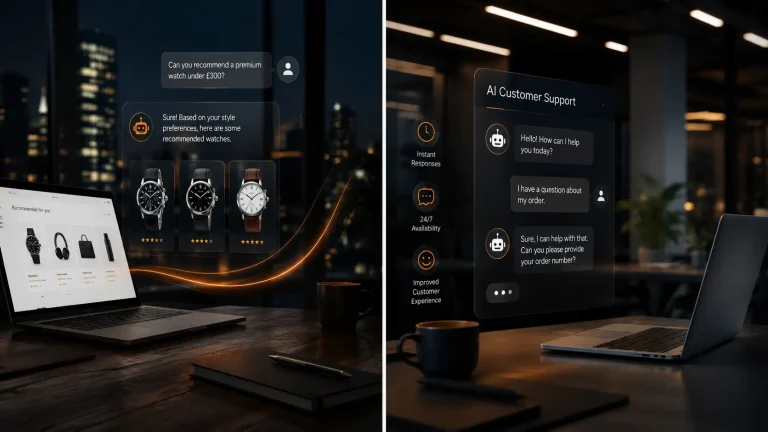
AI Customer Support introduces a reliable first layer of assistance. It can answer common questions, explain policies, guide customers through simple processes and collect useful information before a case reaches a person.
AI Customer Support uses conversational artificial intelligence to understand customer questions, provide approved answers, guide users through support processes and transfer complex or sensitive cases to a human agent when necessary.
Used properly, it does not remove people from customer service. It helps teams reserve human attention for the situations where judgement, reassurance, negotiation or empathy genuinely matter.
What an AI Customer Support Chatbot Actually Does
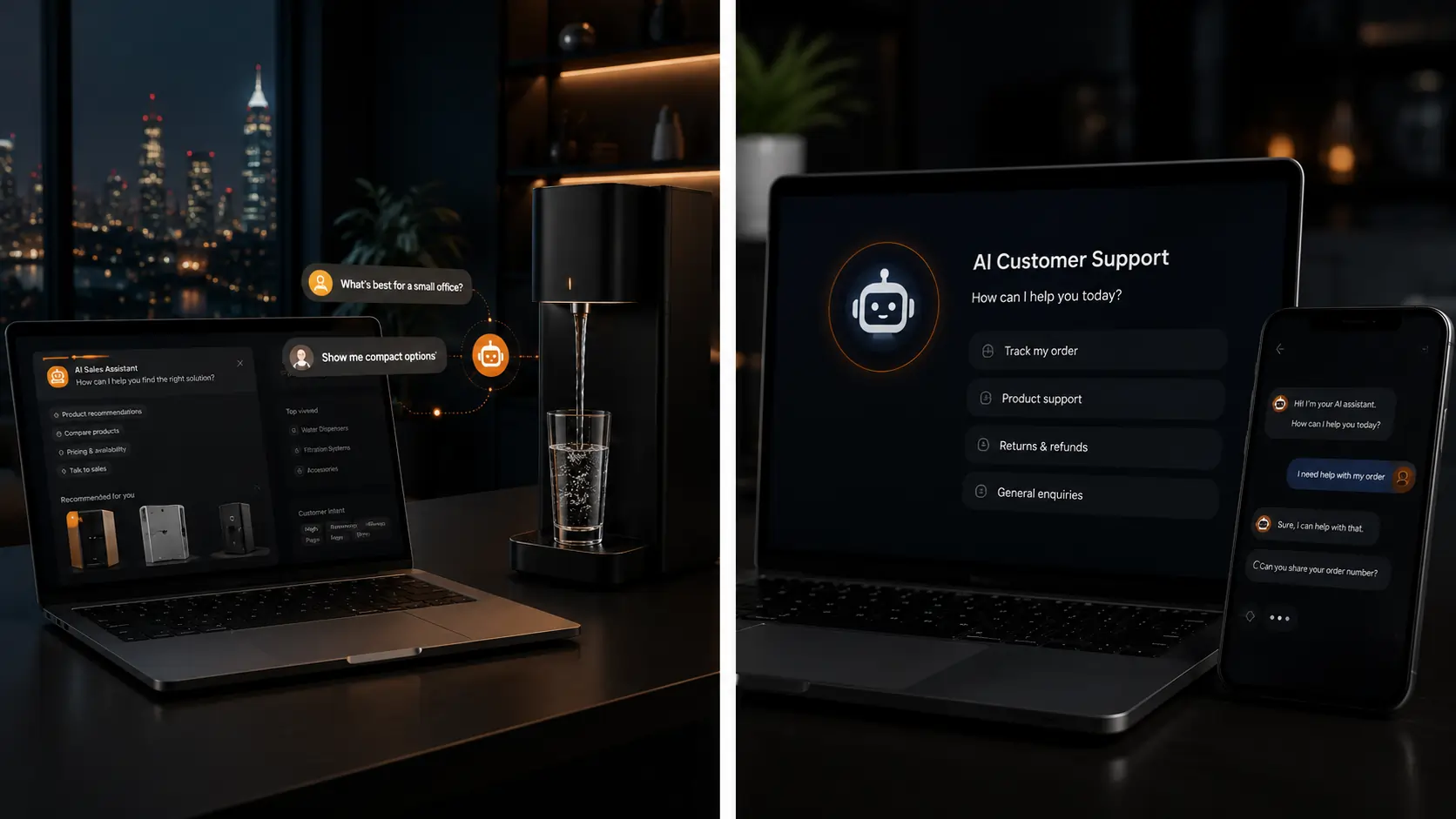
An AI support chatbot provides a conversational route into a company's approved support information and service processes. Instead of requiring a customer to search several pages, it allows them to describe the issue in ordinary language.
The assistant identifies the likely intent, retrieves relevant information and responds within the limits defined by the business. Depending on the implementation, it may be able to:
- Answer questions about products, services and company policies.
- Explain delivery, cancellation, return and refund processes.
- Guide customers through account access or booking steps.
- Provide approved troubleshooting instructions.
- Collect the information needed to create a useful support ticket.
- Route the enquiry to the correct team.
- Recognise when a conversation requires human intervention.
- Provide support outside normal business hours.
A basic chatbot generally follows fixed buttons and scripted paths. A modern AI assistant can understand a wider range of wording and maintain a more natural conversation. That flexibility still requires control.
The assistant should use verified content, avoid unsupported claims and make uncertainty clear. Where a standard setup is not enough, custom AI development can connect the chatbot with internal systems and specialist workflows.
AITC provides AI chatbot services for UK organisations seeking faster customer service, lower support pressure and a more consistent digital experience.
Why Customer Support Becomes Harder as a Business Grows
Customer service problems are not always caused by poor staff performance. They often develop because enquiry volume and operational complexity grow faster than the support process.
Repetitive questions consume capacity
Delivery, account, pricing, booking and policy questions can occupy a large part of the working day even when the answers rarely change.
Information sits in different places
Advisers may need to search emails, documents, order systems and internal notes before they can provide a reliable answer.
Responses vary
Different team members may describe the same policy differently, creating confusion and avoidable follow-up.
Simple cases wait behind complex ones
A basic request can sit in the same queue as complaints, technical investigations and account disputes.
AI customer support creates a first layer of triage. Straightforward enquiries can be resolved immediately. More complex cases can be categorised, documented and routed to the right person with useful context.
How AI Chatbots Improve Customer Service
Faster first responses
Customers receive immediate guidance rather than waiting for an adviser to become available.
More consistent answers
The assistant uses approved information and follows the same service rules across every conversation.
Lower support pressure
Routine questions are handled automatically, giving staff more time for cases that require human judgement.
Better case preparation
The assistant can collect order numbers, account details, issue type and previous steps before handover.
Customers receive help when they need it
Support demand does not stop at 5pm. Customers may check an order in the evening, attempt to change a booking on Sunday or need product guidance before an early appointment. An AI support chatbot can provide approved assistance at those moments.
Teams spend less time repeating the same answers
Many support departments answer a relatively small number of questions again and again. Automating those conversations can reduce queue length without lowering service quality.
Enquiries reach the right person faster
Customers often choose the wrong contact form or department because the internal structure of the business is not obvious to them. An AI customer assistant can identify the issue and direct it correctly.
The business learns from customer conversations
Conversation data can reveal missing website information, confusing policies, recurring product issues and areas where customers repeatedly become stuck. These insights can improve more than the chatbot; they can improve the wider service operation.

AI Customer Support Use Cases for UK Businesses
| Business type | Common support issue | How AI can help |
|---|---|---|
| Ecommerce retailer | Delivery, return, product and order-status questions | Explains approved policies, guides customers to tracking and collects order details before escalation |
| Professional services firm | Appointment, document and process questions | Explains next steps, preparation requirements and contact routes |
| Property or facilities business | Maintenance requests arrive without enough information | Collects location, urgency, issue type and access information |
| Technology provider | Users need basic troubleshooting before raising a ticket | Guides customers through approved checks and records results for the technical team |
| Education or training provider | Learners ask about access, schedules, eligibility and certificates | Provides programme guidance and routes exceptional cases |
| Membership organisation | Members need help with renewals, benefits and account access | Answers routine membership questions and supports account journeys |
Example: ecommerce support
An ecommerce business may receive large numbers of messages asking where an order is, whether an item can be returned or which product is compatible with another. An AI assistant can answer policy questions and guide customers to the correct self-service route.
Where account-specific information is required, the assistant can request an order reference and pass the case to a person or connected system.
Example: professional services
A consultancy, clinic or legal-services firm may receive repeated questions about appointments, documents and what happens next. An AI customer assistant can explain the general process while avoiding advice that requires a qualified professional.
Example: technical support
A software or equipment provider can use AI to guide customers through approved first-line checks. If the issue remains unresolved, the chatbot can provide the technical team with a structured summary of the symptoms and actions already attempted.
AI Customer Support vs Human Support
The strongest service model is usually not AI or people. It is AI and people, with clear responsibilities for each.
| Service area | AI support | Human support |
|---|---|---|
| Availability | Can operate continuously | Limited by staffing hours and capacity |
| Routine questions | Fast and consistent | Useful but expensive when repeated at scale |
| Complex judgement | Should remain within defined limits | Better for exceptions and ambiguous situations |
| Empathy | Can use considerate language but should not imitate human understanding | Essential for complaints, distress and sensitive issues |
| Negotiation | Suitable only where rules are clear | Better for discretion, compromise and commercial judgement |
| Volume | Can handle many conversations at once | Limited by the number of available advisers |
A well-designed system handles routine enquiries first, then escalates cases based on urgency, risk, complexity or customer request.
How to Implement AI Customer Support Properly
The technology should follow the service strategy, not define it. Before choosing a platform, the business should understand which enquiries are suitable for automation and what a good customer outcome looks like.
- Review real customer enquiries.
Analyse emails, chat transcripts, call reasons and support tickets to identify repeatable questions and common failure points. - Define the assistant's responsibilities.
Decide which questions it may answer, which processes it may guide and which cases must go directly to a person. - Prepare approved support knowledge.
Consolidate policies, product information, troubleshooting instructions and escalation rules into reliable source material. - Design escalation paths.
Specify what happens when the assistant is uncertain, the customer requests a person or the issue involves risk, complaint or vulnerability. - Connect relevant systems.
Where appropriate, integrate ticketing, CRM, booking, account or order systems. - Test real-world language.
Customers do not always use the terms found in internal documents. Test spelling errors, vague descriptions and unexpected wording. - Train the service team.
Staff need to understand what the assistant can do, what information it collects and how handovers appear in existing workflows. - Improve it continuously.
Review failed conversations, unresolved questions, escalation reasons and customer feedback after launch.
Businesses considering implementation can explore the AITC website, review client results and read further guidance in AITC Insights.
An AI Chatbot Is Only as Reliable as the Information Behind It
A support assistant cannot provide dependable service if its source information is incomplete, contradictory or out of date.
Before launch, businesses should identify the approved source for each type of answer. Product information may come from a catalogue. Policy answers may come from controlled documents. Account-specific answers may require a secure connection to an internal platform.
Useful sources may include:
- Frequently asked questions and support articles.
- Delivery, returns, cancellation and refund policies.
- Product manuals and troubleshooting guides.
- Service descriptions and eligibility rules.
- Account, booking or order systems.
- CRM and ticketing platforms.
- Approved escalation procedures.
The chatbot should not be given uncontrolled access to every internal document. Information should be selected according to customer need, accuracy, confidentiality and the assistant's defined role.
For technical implementation guidance, businesses should use official documentation from providers such as OpenAI and Microsoft Learn. Search visibility and website quality should continue to follow established guidance from Google Search Central.
What Should a Business Measure?
The number of chatbot conversations does not prove that customer service has improved. Businesses should measure customer outcomes and operational impact.
- First-response time.
- Percentage of enquiries resolved without human intervention.
- Human escalation rate and reasons for escalation.
- Customer satisfaction after AI-assisted conversations.
- Repeat-contact rate for the same issue.
- Average handling time after handover.
- Support ticket volume by category.
- Questions the assistant could not answer.
- Changes in complaint or abandonment rates.
- Staff capacity released for complex work.
These figures should be reviewed together. A high automated-resolution rate is not positive if customers are receiving weak answers or giving up before they reach a person.
The purpose of measurement is to improve the service, not simply to justify automation.
Customer Support Automation Requires Clear Governance
An AI support chatbot speaks on behalf of the business. It may handle account details, complaints, personal information and questions that affect customer rights. Governance cannot be added as an afterthought.
Essential safeguards include:
- Use verified and current business information.
- Prevent the assistant from inventing policies, refunds or guarantees.
- Explain when an answer requires human confirmation.
- Provide clear escalation for complaints and sensitive matters.
- Collect only information needed for the support task.
- Review data protection, storage and retention requirements.
- Control access to customer conversations.
- Maintain an accountable owner for chatbot content and performance.
- Test the assistant whenever policies or systems change.
Businesses should also consider accessibility. Customers may use assistive technology, have limited digital confidence or communicate in different ways. The chatbot should not become a barrier to service.
AITC can help organisations assess these operational requirements alongside chatbot design and implementation. Learn more about AI chatbots for UK businesses or discuss a tailored system through the AITC contact page.
Give Customers Faster Answers Without Overloading Your Service Team
AITC can assess your existing customer journey, identify the enquiries suitable for automation and design an AI support assistant around your approved information, escalation rules and business systems.
The objective is not to install a generic chat box. It is to create a dependable service channel that improves response times, supports staff and gives customers a clearer route to resolution.
Discuss AI Customer Support with AITCAI Customer Support FAQs
What is an AI customer support chatbot?
An AI customer support chatbot is a conversational assistant that understands customer questions, provides approved information, guides users through support processes and escalates cases that require human attention.
How can AI improve customer service?
AI can improve customer service by reducing first-response times, answering routine questions consistently, collecting useful case information and allowing staff to focus on complex or sensitive enquiries.
Can AI customer support operate 24 hours a day?
Yes. An AI support chatbot can provide approved assistance outside normal working hours. Human escalation may still depend on staff availability and the urgency of the issue.
Will an AI chatbot replace customer service staff?
In most organisations, it should support rather than replace customer service staff. AI is best used for routine enquiries, first-line guidance and case preparation, while people manage situations requiring judgement, empathy or negotiation.
What customer questions can an AI chatbot answer?
It can answer approved questions about products, delivery, returns, bookings, policies, account processes and basic troubleshooting. The exact scope depends on the information and systems available to it.
Can an AI chatbot connect to order or booking systems?
Yes, where secure integrations are available. A custom implementation may connect the chatbot with CRM, ticketing, ecommerce, account or booking systems.
What happens when the chatbot cannot answer?
It should explain that the question requires further help, collect relevant details and transfer or route the case to a person. It should not guess or invent an answer.
How long does AI customer support implementation take?
The timescale depends on the number of support topics, quality of source information, required integrations, testing needs and the complexity of escalation workflows.
How do businesses measure AI support performance?
Useful measures include response time, resolution rate, escalation rate, repeat contact, customer satisfaction, unanswered questions and staff time released for more complex work.
Is AI customer support suitable for small UK businesses?
Yes, particularly where a small team receives repeat questions, supports customers outside office hours or needs a more consistent way to qualify and route enquiries.
Smarter Support Begins with Better Service Design
AI Customer Support can help UK businesses respond faster, reduce repetitive workload and give customers more consistent help across the digital journey.
The strongest results come from clear service objectives, reliable information, sensible escalation rules and regular performance review. The technology should support the customer experience rather than become another obstacle within it.
Start by reviewing the questions customers ask most often, the reasons cases are delayed and the points where staff repeat the same work. Those findings provide a practical foundation for a support assistant that delivers genuine operational value.
To discuss a customer support chatbot designed around your organisation, contact AITC.